Thursday, April 19, 2012

Assignment 3: Drawing Outdooors

A Sketchbook Walk
360 degree Studies

Cloud Formations
 Chalk and Charcoal

Oil Pastel
Conte Pastel
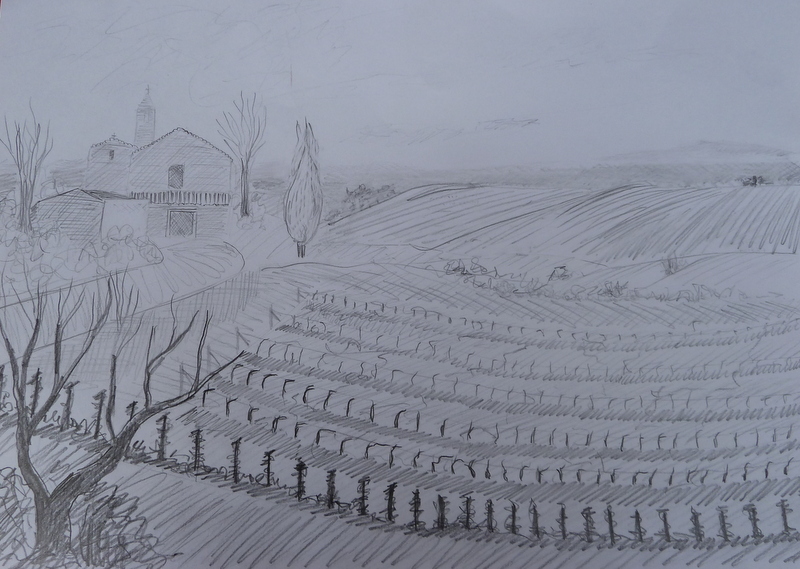
 Plotting space through composition and structure
Check and Log
Q: In what way did you simplify and select in your study?  Were you able to focus on simple shapes and patterns amid all the visual information available to you?
A: Using a viewfinder I was able to simplify and select the area that I wanted to draw.  I am very familiar with this area and have often done sketches and quick water colour paintings so I instinctively knew what to draw.
I was very aware of the distinct areas of light and dark and try to emphasis these areas in the sketches.
 
Q: How did you create a sense of distance and form in your sketches?
A: I tried to use light and dark areas to create a sense of distance and form in the sketches.  The use of darker grafite pencils helped me to define the foreground, middle and back grounds.
Q: How did you use light and shade? Was it successful?
A:  I think that I was successful in my use of light and dark or I tried to be.
Q: What additional work would have been helpful towards the larger study?
A: I think that as with all work the more time you spend the better it is, however, sometimes you just have to stop and move on to the next piece.
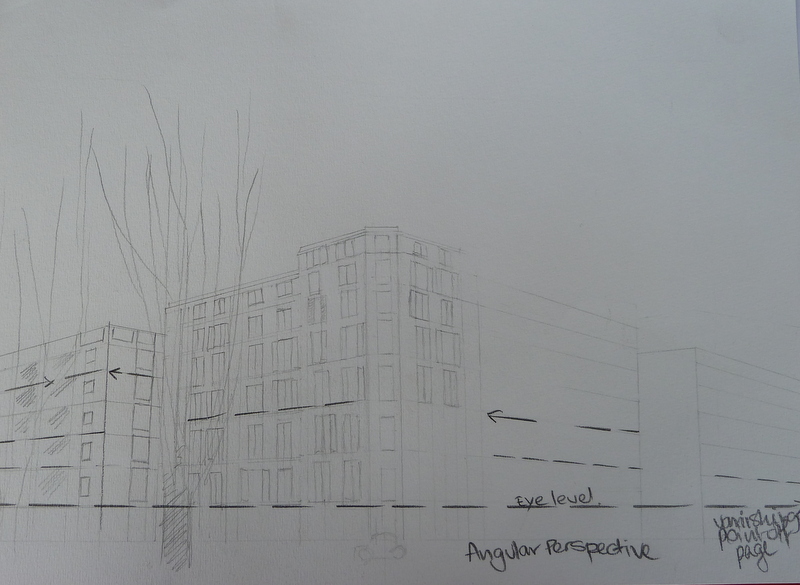
I spent hours on this sketch as I have been unable to work out perspective, finally however, I did understand so the time was not wasted.

Check and Log
Q:What problems did you find in executing perspective drawings? 
A:  The biggest problem for me was not understanding the vanishing point can move, but once I understood this it was easier.  But to draw buildings there is so much to put in and I found that a bit overwhelming.

Q: Make notes on the merits of using, or not using rulers to guide you?
A: I like to draw without a ruler the initial beginning of the sketch to get the general layout of the scene.  I then like to check with a ruler to see that the lines are correct.  Ususally I was very close to the correct placement of the lines.  I purchased a metre long ruler to make sure that the lines were correct.  I have learned a lot during these exercises.  In the past I would never have considered the possibility of drawing a townscape as I did not understand perspective.

 Townscape using line


A townscape, the view from my balcony, the car driving down white lines in the street is a regular sight on the streets of Rome

A sketchbook of townscape drawings.  A bit difficult to see, but its a drawing of a real estate office on the corner of two small streets, one going up the hill in a little village called Nemi.
Limited palette study from a sketch.
Drawing Statues, unfortunately this beautiful horse and roman rider is galloping off the page!

Check and Log
Q; How did you use a limited colour palette to create a sense of depth? 
A: Using all three colours to make the darkest value created a sense of depth, I think.

Q: Did your preliminary sketches give you enough information for your final pieces of work?
A: I think that they greatly assisted my efforts to get things in the correct places.
Q; Would you approach this task differently another time?
A: I would have to say I would but just now I am not sure.  I like to try to make a fresh approach to each study.
Q: Have you got the scale of the buildings right?  Make notes on what worked and what did not.
A:  I think I have the scale of the buildings right and I think that what I did worked.  Of course the more experience you have in anything the better you will be.  More practice will make things work better.
Q: Have you captured the colour and atmosphere in your studies? How did you do this?
A: I tried too capture the colour and atmosphere but using only three colours it was difficult for me.

 Larger study of individual tree.
Study of several trees.
Check and Log
Q: How many different types of tree types have I drawn?
A:  Throughout this assignment I have drawn many types of trees. I really enjoy drawing trees.

Q: What techniques did you use to distinguish each type?
A:  I tried to draw the actual over all shapes of different types of trees and the line that the leaves make.  Some trees like cyprus for instance are long and skinny and have long skinny branches that go straight up and others are short and round.

Q: What did you do to convey the mass of foliage?
A:  I used different grades of grafite pencil and charcoal pencil and different kinds of lines and shapes.

Q: How did you handle light on the trees?  Was it successful?
A:  I used a lighter touch with the pencil or charcoal I think it was successful.

Q; Did you manage to select and simplify?  Look at your drawings and make notes on how you did this and what you could do better.
A: Its always a challenge to choose exactly what to draw.  I tried to look at the overall shapes, textures and the light and dark of what I chose to draw.  I am sure that I can do better and will try to next time.


This is the final piece.  I found it very difficult as I have avoided drawing buildings in the past.  I think that the perspective is ok, but struggled with which details to include and which to omit.  I have spent many hours and could continue but I had to stop at some point.


Research Point: Artists who Divide Landscapes into Forground, Middle Ground and Background.

Claude Lorrain born in 1604 or 1605, died 1682.
It was not until the middle of the 17th century that landscapes were considered as serious paintings in Rome where Lorrain lived.  The traditional art was either mythical or religious. Lorrain painted the Italian landscape in very conscious sections of the foreground, middle and back grounds.  As you can see in these two paintings:
 Landscape with the Heliads searching for their brother Phaeton (oil on canvas)
It has been written that Claude Lorrain did not like to paint figures and had other artist paint them for him on some of his works. (wikipedia)
 

Landscape with Castle

In this example you can see the foreground consists of the larger trees, the middle ground with smaller trees and hill and the castle and sky in the background.  
 
JMW TURNER 1775 - 1851
Fortunately for Turner he achieved financial independence relatively early in life and was able to paint following his ideas as opposed to having to paint for survival.  His early works show defined sections of his landscapes such as this painting:
Ivy Bridge 1813
The forground of rock, trees and water, Middle ground of the carriage on the bridge and buildings and then the background of the clouds in the sky.  
In this painting ''Banished from Rome'' 1838 the sections are still defined but less clearly than the earlier works.  This is a magnificent painting,  his beautiful drawing and use of colour is truly inspiring.
Turners later works show that he is not so concerned with the defined sections of fore, middle and background but more interested in colour and design, such as these two examples.
 The Slave Ship 1840
'Sun Setting over the Lake' 1840


Friday, March 30, 2012

Challenged faced by Famous Artists

Paul Cezanne  1798 – 1886
Cezanne struggled most of his life to observe his subjects and to paint accurately.  He eventually saw the subjects such as landscapes, figures and still life in ‘simple forms and colour planes’, he states in www.wikipedia.com.
He was interested in simplifying natural shapes into their geometric shapes such as cylinders, spheres, and cones.  Cezanne broke down his subjects into these basic shapes and used them as the basis for his subjects, such as spheres for apples and oranges and cylinders for tree trunks.
 Still Life with a Curtain - Paul Cezanne 1895


Claude Monet 1840 -1926

Disillusioned with the traditional art taught at art schools, in 1862 Monet became a student of Charles Gleyre in Paris, where he met Pierre-Auguste Renoir, Frédéric Bazille and Alfred Sisley. Together they shared new approaches to art, ‘’painting the effects of light en plein air with broken color and rapid brushstrokes, in what later came to be known as Impressionism.’’ www.wikipedia.com
Monet went to England in the 1970's and studied the art of Constable and Turner who landscapes inspired his study of colour. 
In later years he moved to Giverny and developed his beautiful gardens, famous Japanese bridge which he  painted in all seasons.   I was fortunate enough to visit Giverny a while ago, and it was truly breathtaking.  It was easy to see the joy of his gardens in the paintings for the world to enjoy.
Bridge of Pond of Water Lilies 1899


Monday, March 12, 2012

Pentimenti


Pentimenti“A painter’s term for the evidence in a work that the original composition has been changed. Often the opaque pigment with which the artist covered a mistake or unwanted beginnings will, with time or injudicious cleaning, become transparent, and a revelation of original intentions will become visible through the finished composition.” Columbia Encyclopedia

RICHARD DIEBENKORN (1922-1993) Was a well known american artist who art included many areas of ‘pentimenti’ in his works.
Ocean Park No. 79 - 1975

A painting by Caravaggio called 'The Cardsharps contains pentimenti  but it is only seen by infra-red light, which suggestes that the position of the figure on the right has been changed.

The importance of penitmenti is considered in the case of an old master, if a painting is actually the first version of a subject or a second or third version. Many artists such as Caravaggio did not appear to do many drawings before beginning a painting and therefore worked out the composition straight on to the canvas.  Many pentimenti are found in the works of these particular artists.  The artists included Picasso, Mattise, Innes, Rembrandt and Titan, just to name a few.

Some paintings have been painted over the top of another painting of a different subject such as 'The Old Guitarist' by Picasso are not seen as pentimenti, but that is debatable I would suggest.  Who is to say that the face in the background of this painting is not the same person as painted in the final work?


Velazquez portrait of King Philip shows the very obvious changes, pentimenti, in his left leg, glove and his musket.  It is said that he looked after the decoration in the king's palace and would walk past his paintings and often make changes to them.

Wednesday, January 18, 2012

Books I am reading: THE STORY OF ART, E.H.GOMBRICH

The Story of Art    by E. H. Gombrich

He begins the book saying that there is no good or bad art and asks the question ‘’which work of art is not?’’
Gombrich states ‘’The trouble with beauty is that tastes and standards of what is beautiful vary so much.’’
His book is very thick and heavy but it is very understandable.  He begins with the cave paintings of prehistoric times and moves on to the Egyptians who became the leaders of the world in art some five thousand years ago.   Their method of drawing was childlike and repetitious ‘’everything had to be represented from its most characteristic angle’’ says Gombrich.  If you look at figures of the early Egyptian art you can see that all the figures are very similar.  There were rules, almost laws to painting and all artists obeyed them. 


Detail of figure in wall-painting from the tomb of Khnumhotep, c. 1900 BC.


For 3000 years nothing changed and the art stayed the same.  A heretic king, Amenophis IV was the first to break with the old traditions.  He wanted the paintings he commissioned to be more real and life like as seen in this piece.

Aknaten and Nefertiti with their children c.1345 BC

 If you look at the painting it almost looks 'cartoonish' (my word) with the king kissing his child, and the other two children interacting with the mother.  A vast difference from the normal in that period.


His reign ended and the new king did not embrace the new changes in art and soon returned to the old rules of art.   However, this painting of Tutunkamun and his wife were found in his tomb c. 1330 BC.  This work of art is much more realistic than the older style.


The purpose of art in that time was to record their lives and history, as decorations in there tombs.  The job of the artist ‘’resembled a map-maker rather than that of a painter’’, states Gombrich.  
The purpose of art in that time was to record their lives and history, as decorations in there tombs.  The Egyptians also taught many Greek artists their methods of painting so much of the early Greek art looks like the art from Egypt.  

Greek art in the first few centuries was very primitive as seen in this vase named:

''The Morning of the Dead''  c. 700 BC
The Greeks gradually began to produce figures that where more life like rather than following the rules and methods. As this vase shows:
''Achilles and Ajax Playing Draughts'' c. 640 BC

Unfortunately most of the stone statues were carved in the likeness of one of the Gods worshiped during that time and were destroyed with the onset of Christianity.  The Christians only wanted one God. Most Greek statues in the world today are copies of the original works.  Such as this statue named :
''Athena Parthenos'' c. 447 - 432 BC

This statue was copied by the Romans in marble.  The original of this statue as stated by the author says ''it was like a gigantic wooden image, some 36 feet(11 metres) high, as high as a tree, covered all over with precious materials, the armor and garments of gold, the skin of ivory.'' The statue would have never survived the centuries.
By the end of the 5th century artists began to change from craftsmen who did their work following the rules and established methods to some what free spirits who were able to interpret what they saw in their own unique way.
 ''Hermes with the young Dionysus'' c. 340BC
This artist Praxiteles was according to Gombrich was ''the greatest artist of the century. Unfortunately most of his works disappeared.''  This particular piece was found in Olympia during the 19th Century and it is believed to be an original.  This statue shows the progress made by the Greeks in reproducing an image of a figure compared to the Egyptians.

Probably one of the most well known works of art at that time was found on the Island of Melos:

''Venus of Milo'' c. 200 BC


''Some of the works of the classical sculpture which have enjoyed the greatest fame in later times were created in the Hellenistic period'' states Gombrich.  One of these sculptures called:

''Laocoon and his Sons'' c. 175 - 50 BC


I was facinated by the description of this sculpture.  The statue represents a scene which ''was described in Virgil's Aeneid''(Gombrich) about two serpents coming from the sea to catch a priest and his two sons....''.
I was actually fortunate enough to see this incredible work of art in an exhibition in Venice in November last year.  I could hardly believe my eyes.  

Around this time in history wealthy people began to collect works of art, and if they could not buy the original they would pay huge prices for artists to copy the originals.  During this time painters were the most important artists with many stories being written about them.   There were stories about artists who ''painted from everyday life'' states (Gombrich) but sadly most of this work has been lost.  With the exception of Pompeii which was buried under the ashes of Mt Vesuvius which erupted in 79 AD.  

This is an example which can still be seen in Pompeii today depicting ordinary life of people standing around watching people play games.


From the 1st to the 4th century when the Romans were conquering the word art remained more or less the same.  The artists who did work were mainly Greeks and  ''most Roman collectors bought works of the great Greek masters, or copies of them''. 
''When Rome became mistress of the world'' (Gombrich) the artists were required to put their skills to other uses such as civil engineering.  Roads, aqueducts, public baths and of course incredibly impressive buildings  such as the Colosseum.

Another equally as impressive building is the Pantheon (temple of all Gods).  ''Its interior, is a huge round hall with a vaulted roof and a circular opening at the top through which one sees the open sky.  There is no other window, but the whole room receives ample like from above'' is a very adequate description of Gombrich as it is still today a magnificent building.
I have been fortunate enough to be there when it has been raining and the priests put a rope barrier around the area in the middle that is wet and everything goes on as normal. it was converted into a church in the early christian era and as such was never allowed to fall into disrepair, it is still a church that has services and it was built in 130 AD.

Another task given to the artists was to carve great columns to create records of the Romans' victories and their campaigns.  The art of Rome at the time was very basic and down to earth.  ''.... the Roman way of telling a story and glorifying a hero was adopted by artists who set themselves the tasks of illustrating the story of a peaceful conquest, the story of Buddha.''  This happened in the far off destination of India states Gomich.  The Indians created an image of the Head of Buddha in the same way that the Romans and Greeks had produced beautiful images of gods and heroes.